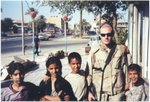

Use of American military forces abroad has always been a contentious issue. In question more broadly has been the conflict between two ideologies, Isolationism and Globalism (or internationalism; or interventionism). The debate between the two in America goes back to its genesis; the debate over whether America should keep to its own borders, or if its interests require, that it exert its influence abroad.
At the outset of the Second World War in Europe, American public opinion was largely opposed to the committal of US forces to that theater. The opinion was largely, “Let the Europeans deal with their own mess!” After all, America had intervened in World War One and the Europeans clearly hadn’t learned their lesson. Roosevelt had wanted to commit American forces to the European theater long before the Japanese Attack on Pearl Harbor and it was American public opinion that prevented him. He needed the Japanese awakening to persuade the American public that American intervention in Europe was necessary. It was public opinion, ultimately, that brought the United States of America into the Second World War.
America’s engagement in Vietnam largely ended as a result of tremendous public pressure, or negative public opinion. Over the decade long war, the Vietnam conflict garnered increasing public criticism. In this instance, Isolationism had grown in the arena of foreign policy as a result of the Second World War and the Korean conflict. As Vietnam dragged on, American public opinion grew until finally, under U.S. President Gerald Ford, American troops were completely withdrawn from Vietnam in 1975. The conflict rested upon the premise that democracy’s mortal enemy was communism, and that democracy, in order to prevail on the global stage, needed to stem the tide of communist expansionism. The American public didn’t see things quite in that light. In large part because of the media, American public opinion turned so strongly against Vietnam that Washington finally conceded and removed the last remaining American troops in April, 1975.
In 1993, American forces had been committed to Somalia as part of a UN aid program to protect and distribute relief aid to starving Somalis. The country was run largely by warlords and was in basic anarchy. The American commander in that theater authorized a raid aimed at abducting Mohamed Farrah Aidid, a leading warlord and strongman in Mogadishu, along with several of his top lieutenants. The raid succeeded in part, but failed to net Aidid, and resulted in the deaths of several American soldiers. The media, as in Vietnam, couldn’t get enough of the carnage of war, and succeeded in driving public opinion in opposition to the American presence in Somalia. Many Americans saw Somalia as a lawless, godless region and believed American troops had no place in such a god-forsaken part of the world. It didn’t take long for President Bill Clinton to withdraw American forces.
More recently, with waning public support for “Operation Iraqi Freedom”, President Barack Obama promised in his election campaign that he would withdraw American troops from Iraq. The American public, at least in some part, had begun to desert the Iraq war and see it as another Vietnam. Obama viewed his election, as do all American presidents, as a “referendum” on the former president’s policies, and immediately set out to withdraw American troops from Iraq. Although public opinion is in no way as galvanized against the Iraq war as it was against Vietnam, the people have spoken, and public opinion has again been a part in shaping American policy.
Public opinion will always shape the ebb and flow of the use of military force as well as American policy generally. The nature of a democracy demands it. If public opinion ceased to be a factor in such aspects of government, America would cease to be a democracy.
Showing posts with label Somalia. Show all posts
Showing posts with label Somalia. Show all posts
Wednesday, December 2, 2009


Wednesday, January 17, 2007
White Man's Burden: AFRICA
Two weeks ago the Ethiopian Army invaded Somalia on the eastern coast of Africa (who knew where either of these two places were?). Certainly when one mentions Somalia the immediate thought will be of the Hollywood production “Blackhawk Down”. Of course, who knew that for the last few decades Somalia has been without a functional government and has basically been in a prolonged state of anarchy? Ethiopia, the primarily Christian neighbor to the north, determined it to be in its own national security interests to invade Somalia. Backed by a force of Somalis, dubbed the Somali Army and supposedly a remnant of the virtually nonexistent Somali government, Ethiopia quickly put down the Union of Islamic Courts. The UIC is the element of insurrection that had taken control and established some semblance of order in Somalia. This order, based on Sharia or Islamic Law (as was the order in Afghanistan under the Taliban prior to the U.S. invasion in 2002), seemed more troublesome to the Ethiopian government than did the anarchy that prevailed previously.
The Democratic Republic of Congo, independent from French rule since 1960, has in the past 4 decades experienced several government overthrows, political assassinations, civil wars, rigged elections, more violent civil unrest, and over the last few months has survived an insurgency instigated by a prominent Army General named Laurent Nkunda. Today the government negotiated a peace accord in which his militia will be integrated into the Congo’s army and he will be granted asylum in some foreign country. Who Knew? Even the people at CNN don’t even know. In fact, today CNN’s leading Africa headline reads, “Rebels kill, eat endangered gorillas.” How juvenile is that when there is so much more going on in Africa?
An estimate I saw recently said that by 2010 there will be 18 million orphans in Sub-Saharan Africa (SSA) as a direct result of the spread of AIDS, and a decade from now there will be 42 million AIDS orphans in SSA. 2 percent of the population of the African continent will be orphans by 2010 as a direct result of AIDS, by 2016 more than 4 percent. Right now the number of known AIDS cases worldwide is about 40 million, the number in SSA is 26 million. The number seems to be leveling off but only because of a high rate of death among sufferers. Four countries in SSA are known to have at least 20 percent infection rates among adults; including Swaziland with an adult infection rate of 33.4 percent (1 in 3 adults is currently infected with HIV/AIDS). Only 1 in 10 AIDS cases in SSA are currently treated with antiretroviral drugs.
Rwanda, Sudan, Ivory Coast, Sierra Leone, Burundi, Liberia; civil wars, military coups and overthrows, assassinations, invasions, genocides, AIDS, corruption and abuse of power; in a nutshell Africa is a basket case. In my view this is largely because of the still prevalent, although publicly shunned concept, “White Man’s Burden”. In other words, “why should we white folks care about the barbaric and less intelligent Negros in Africa?” Even today, Africa is being raped of its natural resources (diamonds, oil, tobacco and cotton among them) by the west and being victimized by innumerable corrupt influences from outside.
Over the next few decades, and as this and future generations of young Africans mature and become the future leaders in Africa, Africa will become the world’s greatest nightmare if the civil(ized) and thinking people in the west don’t sit up and take notice.
The Democratic Republic of Congo, independent from French rule since 1960, has in the past 4 decades experienced several government overthrows, political assassinations, civil wars, rigged elections, more violent civil unrest, and over the last few months has survived an insurgency instigated by a prominent Army General named Laurent Nkunda. Today the government negotiated a peace accord in which his militia will be integrated into the Congo’s army and he will be granted asylum in some foreign country. Who Knew? Even the people at CNN don’t even know. In fact, today CNN’s leading Africa headline reads, “Rebels kill, eat endangered gorillas.” How juvenile is that when there is so much more going on in Africa?
An estimate I saw recently said that by 2010 there will be 18 million orphans in Sub-Saharan Africa (SSA) as a direct result of the spread of AIDS, and a decade from now there will be 42 million AIDS orphans in SSA. 2 percent of the population of the African continent will be orphans by 2010 as a direct result of AIDS, by 2016 more than 4 percent. Right now the number of known AIDS cases worldwide is about 40 million, the number in SSA is 26 million. The number seems to be leveling off but only because of a high rate of death among sufferers. Four countries in SSA are known to have at least 20 percent infection rates among adults; including Swaziland with an adult infection rate of 33.4 percent (1 in 3 adults is currently infected with HIV/AIDS). Only 1 in 10 AIDS cases in SSA are currently treated with antiretroviral drugs.
Rwanda, Sudan, Ivory Coast, Sierra Leone, Burundi, Liberia; civil wars, military coups and overthrows, assassinations, invasions, genocides, AIDS, corruption and abuse of power; in a nutshell Africa is a basket case. In my view this is largely because of the still prevalent, although publicly shunned concept, “White Man’s Burden”. In other words, “why should we white folks care about the barbaric and less intelligent Negros in Africa?” Even today, Africa is being raped of its natural resources (diamonds, oil, tobacco and cotton among them) by the west and being victimized by innumerable corrupt influences from outside.
Over the next few decades, and as this and future generations of young Africans mature and become the future leaders in Africa, Africa will become the world’s greatest nightmare if the civil(ized) and thinking people in the west don’t sit up and take notice.
Subscribe to:
Posts (Atom)

