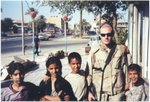

Use of American military forces abroad has always been a contentious issue. In question more broadly has been the conflict between two ideologies, Isolationism and Globalism (or internationalism; or interventionism). The debate between the two in America goes back to its genesis; the debate over whether America should keep to its own borders, or if its interests require, that it exert its influence abroad.
At the outset of the Second World War in Europe, American public opinion was largely opposed to the committal of US forces to that theater. The opinion was largely, “Let the Europeans deal with their own mess!” After all, America had intervened in World War One and the Europeans clearly hadn’t learned their lesson. Roosevelt had wanted to commit American forces to the European theater long before the Japanese Attack on Pearl Harbor and it was American public opinion that prevented him. He needed the Japanese awakening to persuade the American public that American intervention in Europe was necessary. It was public opinion, ultimately, that brought the United States of America into the Second World War.
America’s engagement in Vietnam largely ended as a result of tremendous public pressure, or negative public opinion. Over the decade long war, the Vietnam conflict garnered increasing public criticism. In this instance, Isolationism had grown in the arena of foreign policy as a result of the Second World War and the Korean conflict. As Vietnam dragged on, American public opinion grew until finally, under U.S. President Gerald Ford, American troops were completely withdrawn from Vietnam in 1975. The conflict rested upon the premise that democracy’s mortal enemy was communism, and that democracy, in order to prevail on the global stage, needed to stem the tide of communist expansionism. The American public didn’t see things quite in that light. In large part because of the media, American public opinion turned so strongly against Vietnam that Washington finally conceded and removed the last remaining American troops in April, 1975.
In 1993, American forces had been committed to Somalia as part of a UN aid program to protect and distribute relief aid to starving Somalis. The country was run largely by warlords and was in basic anarchy. The American commander in that theater authorized a raid aimed at abducting Mohamed Farrah Aidid, a leading warlord and strongman in Mogadishu, along with several of his top lieutenants. The raid succeeded in part, but failed to net Aidid, and resulted in the deaths of several American soldiers. The media, as in Vietnam, couldn’t get enough of the carnage of war, and succeeded in driving public opinion in opposition to the American presence in Somalia. Many Americans saw Somalia as a lawless, godless region and believed American troops had no place in such a god-forsaken part of the world. It didn’t take long for President Bill Clinton to withdraw American forces.
More recently, with waning public support for “Operation Iraqi Freedom”, President Barack Obama promised in his election campaign that he would withdraw American troops from Iraq. The American public, at least in some part, had begun to desert the Iraq war and see it as another Vietnam. Obama viewed his election, as do all American presidents, as a “referendum” on the former president’s policies, and immediately set out to withdraw American troops from Iraq. Although public opinion is in no way as galvanized against the Iraq war as it was against Vietnam, the people have spoken, and public opinion has again been a part in shaping American policy.
Public opinion will always shape the ebb and flow of the use of military force as well as American policy generally. The nature of a democracy demands it. If public opinion ceased to be a factor in such aspects of government, America would cease to be a democracy.
Showing posts with label Korea. Show all posts
Showing posts with label Korea. Show all posts
Wednesday, December 2, 2009


Friday, February 16, 2007
Is Kim Jong-Ill?
Little Kim Jong-il uses bribery and tantrums to maintain his hold on North Korea. His recent outbursts may have been a very deliberate attempt to bolster his waning grasp on power by guaranteeing his minuscule self a further supply of gifts for his inner elite. By the United States and the others providing the agreed upon subsidies, his insignificant autocracy will persist and the problem of North Korea will be handed off to the next generation of world leaders.
His birth was foretold by a pigeon or some other lovely little bird. Much like Jesus, a new star appeared in the heavens to mark the birth of the great Kim Jong-il, and upon his birth, like a little leprechaun, a double rainbow happily danced above the blessed mountain where Kim took his first wee breaths. We idolize and worship you, Kim Jong-il, or so he would expect. Kim was the first son of a Korean refugee, the captain of a Soviet Rifle brigade made up of Chinese and Korean refugees in the Russian Far East.
Following the close of WWII Jong-il’s father, Kim Il-sung, returned to Pyongyang from the Soviet Union. Backed by the Soviets, Il-sung became the leader of the Provisional People’s Committee, and later through purges, intrigue, and assassinations, he became the head of the Communist Party in the Korean north. Later, when the Soviets established the new state of the Democratic People’s Republic of Korea (otherwise known as North Korea), the older Kim was appointed Prime Minister. Kim the younger took the reigns following his deified father’s death.
The miraculously born despot has a few apparent phobias including pteromerhanophobia - fear of flying (he travels by armored train), migrusiphobia - fear of being small of stature (he stands 5’3” tall), and athazagoraphobia - fear of being forgotten or ignored (his face and image are on display in every venue in North Korea). Kim Jong-il also has serious problems keeping his vast masculinity under control. The miniature dictator has fathered several children within his several marriages, and fathered several more by numerous mistresses, lovers and secretaries.
Kim’s modest regime stays afloat by the means of its criminal enterprise. As a result of sanctions on his country, Kim engages in the illegal trades of drugs and weapons, extensive money laundering, and counterfeiting, and several other endeavors of a questionable nature. His people starve to death by the millions (more than 2 million to be more precise) and he uses his illicit income to garner support from his military elite. These Kim pays off with imported (or smuggled) food items, liquors, automobiles, prostitutes, homes, income, etc.
Suspicions are rising in the larger outside world that Kim’s hold on power may be, or may have been, in jeopardy. For this reason he recently provoked world indignation by launching missiles and detonating nuclear devices (size doesn’t matter). Such acts, some suspect, were aimed directly at obtaining further financial and material subsidies from the world outside his little micro-cosmos. Recently, the world succumbed to the mounting pressure to deal with the mini-man and proffered many thousands of tons of supplies in all varieties, heavy fuel oil being chief among them. Although Kim may be backed into a corner regarding his hold on power and his people's lack of basic sustenance in his miniature far east, he may have won out once again against the world at large in his efforts to maintain his cult of personality. The reality is that by giving him the subsidies he is looking for, it is the world that is sustaining his iron grip on power, rather than his commanding physique.
His birth was foretold by a pigeon or some other lovely little bird. Much like Jesus, a new star appeared in the heavens to mark the birth of the great Kim Jong-il, and upon his birth, like a little leprechaun, a double rainbow happily danced above the blessed mountain where Kim took his first wee breaths. We idolize and worship you, Kim Jong-il, or so he would expect. Kim was the first son of a Korean refugee, the captain of a Soviet Rifle brigade made up of Chinese and Korean refugees in the Russian Far East.
Following the close of WWII Jong-il’s father, Kim Il-sung, returned to Pyongyang from the Soviet Union. Backed by the Soviets, Il-sung became the leader of the Provisional People’s Committee, and later through purges, intrigue, and assassinations, he became the head of the Communist Party in the Korean north. Later, when the Soviets established the new state of the Democratic People’s Republic of Korea (otherwise known as North Korea), the older Kim was appointed Prime Minister. Kim the younger took the reigns following his deified father’s death.
The miraculously born despot has a few apparent phobias including pteromerhanophobia - fear of flying (he travels by armored train), migrusiphobia - fear of being small of stature (he stands 5’3” tall), and athazagoraphobia - fear of being forgotten or ignored (his face and image are on display in every venue in North Korea). Kim Jong-il also has serious problems keeping his vast masculinity under control. The miniature dictator has fathered several children within his several marriages, and fathered several more by numerous mistresses, lovers and secretaries.
Kim’s modest regime stays afloat by the means of its criminal enterprise. As a result of sanctions on his country, Kim engages in the illegal trades of drugs and weapons, extensive money laundering, and counterfeiting, and several other endeavors of a questionable nature. His people starve to death by the millions (more than 2 million to be more precise) and he uses his illicit income to garner support from his military elite. These Kim pays off with imported (or smuggled) food items, liquors, automobiles, prostitutes, homes, income, etc.
Suspicions are rising in the larger outside world that Kim’s hold on power may be, or may have been, in jeopardy. For this reason he recently provoked world indignation by launching missiles and detonating nuclear devices (size doesn’t matter). Such acts, some suspect, were aimed directly at obtaining further financial and material subsidies from the world outside his little micro-cosmos. Recently, the world succumbed to the mounting pressure to deal with the mini-man and proffered many thousands of tons of supplies in all varieties, heavy fuel oil being chief among them. Although Kim may be backed into a corner regarding his hold on power and his people's lack of basic sustenance in his miniature far east, he may have won out once again against the world at large in his efforts to maintain his cult of personality. The reality is that by giving him the subsidies he is looking for, it is the world that is sustaining his iron grip on power, rather than his commanding physique.
Subscribe to:
Posts (Atom)

